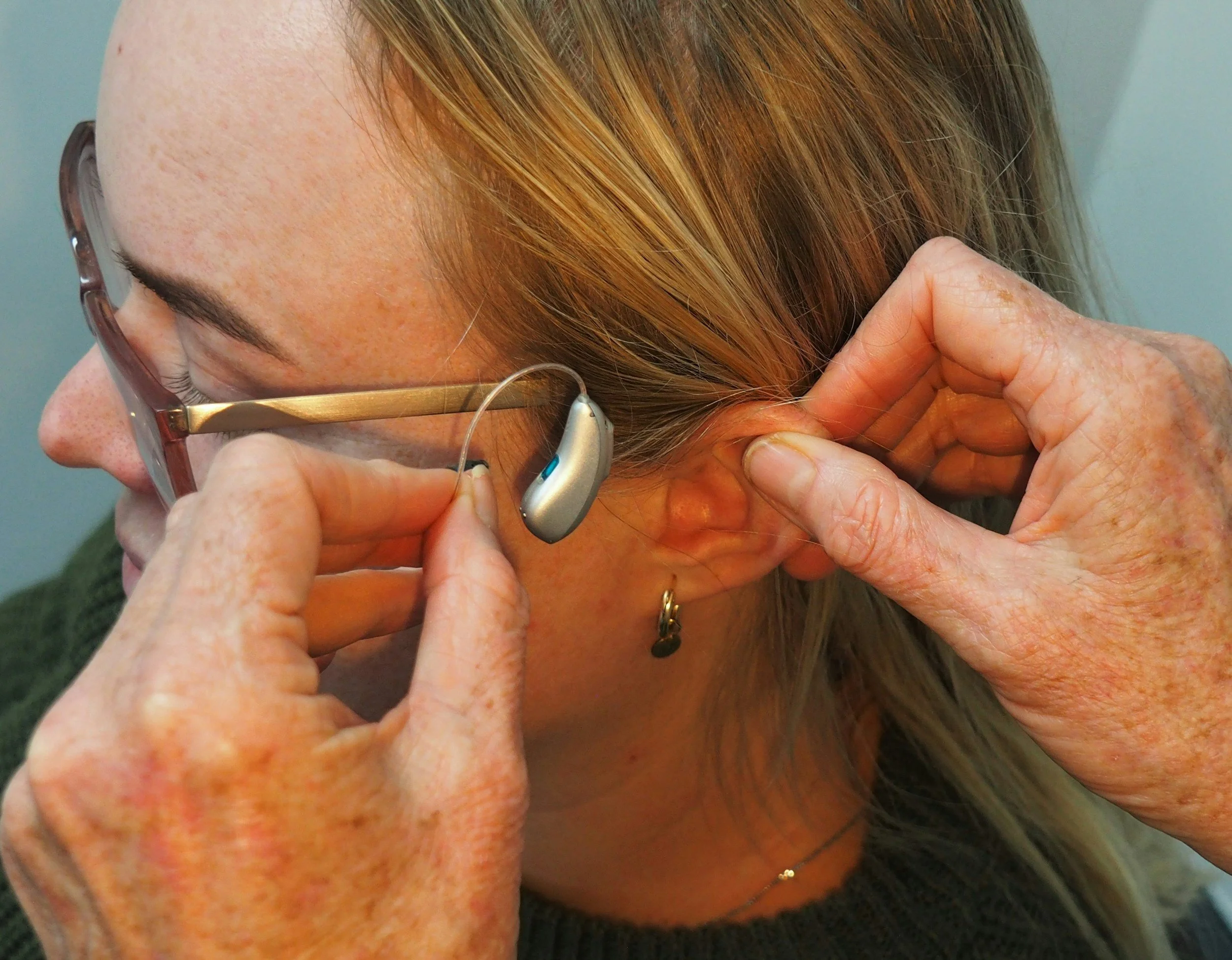
Audiology & Hearing
Hearing Aid Fittings in Pine Bluff, Arkansas
Hearing aids work best when they are professionally fit, verified, and adjusted for your hearing.
At South Arkansas ENT & Hearing, a hearing aid fitting is much more than simply putting hearing aids in your ears and turning them on. Your hearing aids are programmed according to your individual hearing test, verified in your ears, adjusted for comfort and speech clarity, and then fine-tuned over time based on how you actually hear in everyday life.
Our goal is simple: We want your hearing aids to provide the clearest, most comfortable hearing possible—not just in our office, but at home, at work, in restaurants, at church, and everywhere else you need to communicate.
Why the Hearing Aid Fitting Matters
Two patients can purchase the exact same hearing aid and have completely different results. Why? Because the hearing aid itself is only part of the treatment.
The way the device is selected, programmed, verified, adjusted, and supported afterward plays a major role in how well you hear with it.
Modern hearing aids are highly sophisticated medical devices. They can be programmed differently across individual pitches, listening environments, noise levels, and speech situations. That means your hearing aids should not simply be programmed using a manufacturer’s default settings.
At South Arkansas ENT & Hearing, we use your hearing evaluation and professional verification measures to personalize your hearing aids for your ears and your hearing needs.
The appointment
What Happens at Your Hearing Aid Fitting?
1. We Check the Physical Fit
We make sure the hearing aids sit comfortably and securely in or behind your ears. Depending on your hearing loss and ear anatomy, this may include:
- selecting the appropriate dome
- checking receiver or tubing length
- evaluating retention
- fitting a custom earmold when appropriate
- confirming that the hearing aid is comfortable throughout the day
Your hearing aid should feel secure without causing unnecessary pressure or irritation.
2. We Program the Hearing Aids for Your Hearing Loss
Your hearing test shows us how much hearing loss you have at different pitches. We use this information to create an individualized hearing aid prescription.
Rather than turning every sound up equally, modern hearing aids allow us to provide different amounts of amplification for different frequencies and listening levels. The goal is to make important speech sounds audible while keeping louder sounds comfortable.
Verifying the fit
Real Ear Measurement: Verifying the Fit
One of the most important parts of a professional hearing aid fitting is Real Ear Measurement, sometimes called speech mapping.
Real Ear Measurement allows us to measure exactly how much sound your hearing aid is producing inside your own ear canal. Every person’s ear canal is shaped differently. Because of those differences, the same hearing aid can produce different amounts of sound in different ears.
During Real Ear Measurement, a very small microphone tube is placed in the ear canal alongside the hearing aid. We then measure the hearing aid’s response while presenting calibrated speech signals. This allows us to compare the hearing aid output with evidence-based prescription targets and make adjustments when necessary.
Your First Few Weeks With Hearing Aids
Getting hearing aids is not like getting a new pair of glasses. With glasses, the improvement can often feel immediate. Hearing is different.
If certain sounds have been missing for months or years, your brain may need time to become familiar with them again. You may suddenly notice sounds such as:
At first, some of these sounds may seem unusually noticeable. That does not necessarily mean something is wrong. Your brain is receiving information it may not have been hearing clearly before.
This is why follow-up care is such an important part of successful hearing aid treatment.
Follow-Up Visits Are Part of the Fitting Process
We do not believe hearing aids should be fit once and then forgotten. Your real-world experience tells us things that cannot always be learned during the first appointment.
After you begin wearing your hearing aids, we evaluate how you are doing in situations such as:
- conversation at home
- television
- restaurants
- church
- family gatherings
- meetings
- telephone conversations
- riding in the car
- outdoor environments
At your follow-up visits, we may:
- review your experience with the hearing aids
- check physical comfort
- review hours of use
- examine hearing aid data logging
- adjust programming
- fine-tune speech clarity
- adjust loudness or comfort
- activate or modify specialized listening programs
- review Bluetooth or smartphone connectivity
- review cleaning and maintenance
- address any situations in which you are still struggling
Learning your devices
Hearing Aid Orientation
We also want you to feel comfortable actually using your hearing aids. Depending on your devices, we may review:
Tell us
What If My Hearing Aids Still Do Not Sound Right?
Tell us. Hearing aids should not simply be something you tolerate.
If voices sound too sharp, too soft, muffled, tinny, unnatural, excessively loud, or unclear in noise, we want to know.
Many problems can be improved through programming, physical-fit changes, cleaning, verification, or counseling. Sometimes the issue is not the programming at all. Wax, moisture, microphone debris, or a clogged receiver can reduce or completely block sound.
If your rechargeable hearing aid is charging normally or showing its normal charger indicator but there is little or no sound, the hearing aid may simply need professional cleaning. Bring it to our office. In many cases, a deep cleaning can restore the sound without requiring a manufacturer repair.
Hearing Aids Are Only Part of Better Hearing
Even properly fit hearing aids cannot make hearing completely normal. Hearing aids improve access to sound and speech, but successful communication also depends on:
- the degree and type of hearing loss
- word-recognition ability
- background noise
- distance from the speaker
- room acoustics
- visual cues
- communication strategies
That is why we look beyond simply asking, “Are the hearing aids working?” We also want to know, “Are these hearing aids helping you communicate better in the situations that matter to you?”
Measuring Your Progress
Whenever appropriate, we may use standardized hearing questionnaires or individualized listening goals to evaluate how much benefit you are receiving from treatment.
This helps us measure changes in areas such as:
- speech understanding
- hearing in background noise
- communication in reverberant rooms
- comfort with environmental sounds
- participation in conversations
- specific listening situations important to you
The goal is not simply to make the hearing aids louder. The goal is to make your everyday communication easier.
Hearing care with medical support when you need it
The Advantage of ENT and Audiology Care in One Clinic
South Arkansas ENT & Hearing combines hearing healthcare with access to medical ENT care. Most hearing loss can be appropriately managed through audiologic treatment, but sometimes a hearing evaluation identifies something that deserves additional medical attention.
When appropriate, our audiology and ENT services allow us to coordinate evaluation for concerns such as:
- sudden hearing changes
- asymmetric hearing loss
- persistent ear pressure
- chronic ear infections
- drainage
- significant ear pain
- unusual tinnitus
- middle-ear disorders
- medically significant earwax impaction
Our goal
Our Goal: Better Hearing in Real Life
A successful hearing aid fitting is not determined by how the hearing aids sound for five minutes in the office. Success is being able to participate more comfortably in your life.
- Hearing your spouse without repeatedly asking, “What?”
- Following conversation around the dinner table.
- Understanding the sermon at church.
- Watching television at a comfortable volume.
- Hearing your grandchildren more clearly.
- Feeling less exhausted after trying to follow conversation all day.
Your hearing aids are a tool. Our job is to help make sure that tool is working as effectively as possible for you.
Common questions
Frequently Asked Questions About Hearing Aid Fittings
-
The length of the initial fitting depends on your devices and individual needs. We allow enough time to verify the physical fit, program and verify the hearing aids, and teach you how to use them.
-
Not necessarily. Your initial fitting gives us a strong starting point, but many patients benefit from additional adjustments after wearing the hearing aids in real-world environments.
-
Follow-up visits allow us to evaluate comfort, speech understanding, real-world performance, data logging, and your adaptation to amplification.
-
Real Ear Measurement measures the sound produced by your hearing aids inside your ear canal. It allows us to verify whether the hearing aids are appropriately matching your prescribed amplification targets.
-
Yes. A communication partner can provide valuable information about situations in which you have difficulty hearing and can learn strategies that help improve communication.
-
First make sure it is charged. If it is charging normally but still has little or no sound, the device may simply be clogged with wax or debris. Bring it to the clinic so we can inspect and professionally clean it before assuming it needs repair.
Ready to Hear Better?